
Transcript
Announcer:
Welcome to CE on ReachMD. This activity is provided by Global Learning Collaborativeand is part of our MinuteCE curriculum.
Prior to beginning the activity, please be sure to review the faculty and commercial support disclosure statements as well as the learning objectives.
Dr. O’Brien:
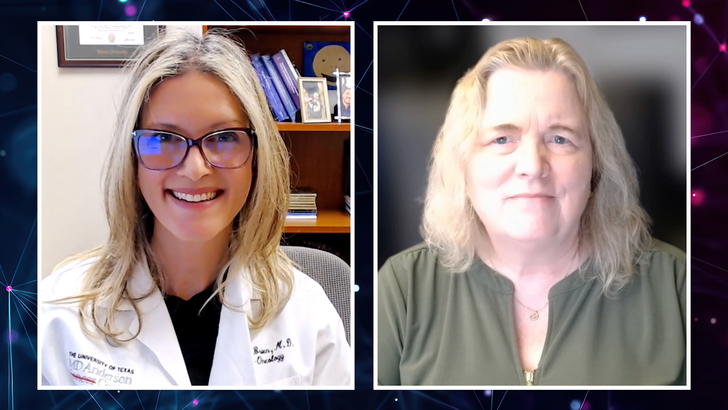
This is CE on ReachMD, and I’m Dr. Barbara O’Brien, a neuro-oncologist at MD Anderson Cancer Center in Houston, Texas.
Dr. Harbeck:
Hi, and I’m Dr. Nadia Harbeck. I’m the Director of the Breast Center at LMU University Hospital in Munich, Germany.
Let’s start our discussion with a case. We have a 34-year-old woman with a HER2-positive, hormone receptor-negative breast cancer on the left side. Clinically, it was a cT2, about 3 cm with positive lymph nodes. We found out that she had multiple small liver mets and several, but small and asymptomatic, brain mets. And we started with T-DXd plus P, and we had to secure reimbursement from the health insurance based on the DB-09 and the FDA approval, but we felt that this was such a high-risk situation that we wanted to give her the best possible first-line treatment.
So Dr. O’Brien, how would you approach this case?
Dr. O’Brien:
Well, this is a young woman with what sounds like an excellent functional status. She’s treatment naive. She has very small, asymptomatic brain mets, and we’re dealing with both disease systemically and in the CNS. And so in this case, I would also favor systemic therapy, specifically with the CNS-active trastuzumab deruxtecan plus pertuzumab, over local therapy such as radiation and certainly over recommending surgery followed by radiation.
And I’m really excited to have this as an option now with the DESTINY-9 trial and supported by DESTINY-12 and the data that we have there for brain mets specifically.
Dr. Harbeck:
Yeah, I completely agree. I think what we thought when we looked at this patient was that she needed systemic therapy. The brain mets were small, they were asymptomatic, so I felt that T-DXd plus P was the best possible choice.
And I think if you look at the data in the DB09, obviously we didn’t have active brain mets, but we had stable brain mets, about 6%, and they really benefited. And the PFS, if I recall correctly, was also independent of the presence of brain mets.
And obviously we also have the DB12 trial, which is very dear to my heart. I have a conflict here. I was one of the co-investigators. But I thought we saw some excellent T-DXd activity in the active brain mets with objective response rates, about 70% to 80%, independent of whether these brain mets were active or stable. And if you look at the one curve in the DB12 where you have the overall survival in the patients with brain mets and those without, even though it wasn’t a randomized trial, both arms had 90% 1-year overall survival. And I thought that these data were really encouraging for patients but also for us as physicians.
The other data we have is the tucatinib data. That’s an active drug, and it’s active in stable brain mets. But this would have been a later-line situation, because the HER2CLIMB trial was done after patients had been treated with trastuzumab, pertuzumab, T-DM1. And the combination of tucatinib, trastuzumab, capecitabine is actually quite active, independent of the presence of brain mets. But also in the patients with active brain mets, there was a substantial prolongation of median overall survival.
So it’s an active combination, but for this patient, I thought it was not appropriate because it’s a later-line situation. And in our current ESMO guidelines, we have T-DXd as the frontline option. So would you agree with that?
Dr. O’Brien:
Yeah, absolutely. And I think it’s very likely that at some point this patient will also be exposed to tucatinib. And I think with the evidence that we have, but also with trastuzumab deruxtecan moved to the front line, this makes complete sense.
I mean, I’ll just echo, it’s fantastic to have both of these options for our patients and to see these benefits. And it’s always the silver lining when we see brain metastasis or even leptomeningeal metastasis when patients have some HER2 expression and we can lean on these drugs.
Dr. Harbeck:
Yeah. I mean, it’s interesting that you’re mentioning the leptomeningeal disease. We have less data for our agents, but I think there is, both for T-DXd but also for tucatinib, there is some data that that would be active as well. But I think the majority of our patients obviously come with asymptomatic because we screen better or with symptomatic brain mets.
So if the patient had had symptomatic brain mets, would you have done something differently in the first-line setting?
Dr. O’Brien:
Yeah, it’s a great question. So if the symptoms were just mild, I probably wouldn’t have done much differently, maybe started them on a low dose of steroid and see if we can provide some benefit to the symptoms, and then continue with the plan for T-DXd.
But if they were more symptomatic or larger or in an area of eloquent brain, that’s when I would be favoring local therapy with either radiation or surgery followed by radiation, because we just have more evidence for that approach, especially if we’re trying to quickly gain control.
Dr. Harbeck:
Yeah. I mean, what about if the patient had had isolated CNS progression?
Dr. O’Brien:
Yeah, these are the questions, right? I mean, I think the cleanest way would be to just treat it with local therapy. But on the other hand, I think it speaks to the bigger question also of distant control in the CNS and ultimately prevention, which we’re still learning about. But I think these are important considerations.
I think the easier question is if someone has systemic control on T-DXd develops 1 or 2 or several brain metastases, and instead of switching from T-DXd to another systemic therapy, continue that to maintain that systemic control. And then on top of that, treat with local therapy with SRS, stereotactic radiosurgery, to those brain metastases.
Dr. Harbeck:
That brings me to one more question. If we decided to go for stereotactic radiosurgery, sometimes there is radionecrosis, which is very difficult to distinguish from oligoprogression or these irradiated metastases. Can you tell us a little bit about this and how would you manage that?
Dr. O’Brien:
Yeah, I mean this is a really real-world scenario. This comes up all the time, not just what to do with the radiation necrosis, but when we’re looking at the imaging, what are we seeing? Is that true tumor progression, or is it radiation necrosis? And there’s some context clues.
One is that we typically see radiation necrosis 6, 12 months, or more after treatment. But sometimes we have to use some advanced imaging techniques to try to sort that out or just give things some time to see how they evolve on imaging. But it’s not an uncommon problem. So up to 25% of patients who have been treated with SRS can develop radiation necrosis, and it’s more common for larger lesions, certainly for lesions that have been treated more than once.
And in terms of prevention, it’s a good question. I mean there’s certainly an element of radiation technique and optimizing radiation techniques. The timing of some of these systemic therapies in relation to giving radiation may also play a role. And then in terms of management, if a patient is not symptomatic, we typically just monitor. We typically just monitor that imaging to see how things evolve.
But if it is symptomatic, we’ll typically start with a short course of steroids. And then if the patient doesn’t tolerate the steroids or certainly if the steroids aren’t providing benefit, then we can consider the VEGF inhibitor bevacizumab, which can provide some beautiful responses, including to symptoms, or surgery or a laser ablation technique called LITT.
Dr. Harbeck:
Yeah, thank you. I think this is the ideal example of how we always have to talk to each other in these multidisciplinary settings, because there are so many things to consider with patients with brain mets now that we have these very strong systemic therapies as well.
Dr. O’Brien:
Agree. Well, this is all the time we have today. Thanks for listening. We hope you found this case review helpful.
Announcer:
You have been listening to CE on ReachMD. This activity is provided by Global Learning Collaborative and is part of our MinuteCE curriculum.
To receive your free CE credit, or to download this activity, go to ReachMD.com/CME. Thank you for listening.
 In support of improving patient care, Global Learning Collaborative (GLC) is jointly accredited by the Accreditation Council for Continuing Medical Education (ACCME), the Accreditation Council for Pharmacy Education (ACPE), and the American Nurses Credentialing Center (ANCC) to provide continuing education for the healthcare team.
  This activity has been accredited by the European Board for Accreditation of Continuing Education for Health Professionals (EBAC®).
  Global Learning Collaborative (GLC) designates this activity for 1.0 contact hour(s)/0.1 CEUs of pharmacy contact hour(s).
  Global Learning Collaborative (GLC) has been authorized by the American Academy of PAs (AAPA) to award AAPA Category 1 CME credit(s) for activities planned in accordance with AAPA CME Criteria. This activity is designated for 1.0 AAPA Category 1 CME credit(s). Approval is valid until 05/07/2027. PAs should claim only the credit commensurate with the extent of their participation in the activity.


